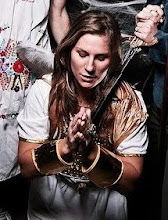
My thoughts turn to numinous images embedded in my psyche: different notions of salvation. One can walk on water and bring the dead back to life with the power of faith.
If hope is to a Buddhist the negative admission of lack, and if hope is to a Christian or Jew the positive admission of desire, then hope is neither indulgence nor necessity. I'm not so sure about hope, though. Maybe there is a hope found in the Middle Way.
The most difficult thing to do is to be yourself: to embrace freedom and your singularity. We spend an inordinate amount of time running away from, instead of toward, ourselves.
I'm on an Easter Egg Hunt. I'm seeking the indestructible within.
Sunday, April 12, 2009

Tuesday, April 7, 2009
Yeah, We've Got It All Fucked Up
We've got it all fucked up when the TV's higher than the temple.
We've got it all fucked up when the money symbol $ is higher than the heavens.
We've got it all fucked up when we grind ourselves to the bone into the deep blue future.
We've got it all fucked up when we've lost face to accompany the pretense of our most banal and mundane dreams.
We've got it all fucked up when the money symbol $ is higher than the heavens.
We've got it all fucked up when we grind ourselves to the bone into the deep blue future.
We've got it all fucked up when we've lost face to accompany the pretense of our most banal and mundane dreams.
Thursday, March 19, 2009
Satiation
Mistaking attachment for love is an easy thing to do. Mistaking addiction for love is also an easy thing to do. The two, attachment and addiction, seem to be intertwined or fruits of the same seed.
We may hold on to a thing because of our attachment or addiction to it, but it doesn't mean that the thing is healthy or right for us.
A drug may feel good, but it has deleterious effects and the feelings are short-lived. The same goes for certain relationships, such as the ones fueled by co-dependency or dependency.
How much we cling to a thing may serve as a litmus test for whether or not it is attachment, addiction, or love.
I'd goes as far to say that the things, particularly relationships, that are healthiest for us are things that do not cause withdrawal or pain during separation. In the first stages of love, we experience the fits of first love: the wanting, needing, lusting, aching. We must be around the other.
Later, as a deeper love comes through, the fits or highs of love subside, as the love/lust is no longer a thirst to be quenched or a hunger to be sated. Like Donne writes in "A Valediction Forbidding Mourning":
...Dull sublunary lovers' love
—Whose soul is sense—cannot admit
Of absence, 'cause it doth remove
The thing which elemented it.
But we by a love so much refined,
That ourselves know not what it is,
Inter-assurèd of the mind,
Care less, eyes, lips and hands to miss.
Our two souls therefore, which are one,
Though I must go, endure not yet
A breach, but an expansion,
Like gold to aery thinness beat.
If they be two, they are two so
As stiff twin compasses are two ;
Thy soul, the fix'd foot, makes no show
To move, but doth, if th' other do.
And though it in the centre sit,
Yet, when the other far doth roam,
It leans, and hearkens after it,
And grows erect, as that comes home.
Love can stand the distance; yet, dull love--such as lust, addiction, or attachment--needs constant attention. The feelings involved in attachment and addiction are heightened, erotic, and impulsive. The feelings involved in love are like a pervasive, quiet hum--constant in its regularity and continuity.
Relationships characterized by attachment and addiction are crutches or substitutes for something going on beneath the surface, perhaps psychologically. Where there may be emptiness or loneliness, relationships characterized by attachment and addiction come in to make full. However, these do not last, as they climax and come to an end, a kind of "coming down" from a high. These "users" are addicted to love and to the drama, passion, and excitement involved.
I'd say that love is not like the satiation that comes from eating a hearty meal, only to be hungry hours later. I'd say that love is the satiation that comes not from needing, but from already being full and wanting to give. It is characterized by reciprocity.
Because of this reciprocal exchange, constancy, and satiation, relationships based on love can withstand the tests of time and distance, as Paolo Marinetti so poignantly framed:
"Watching the distant darkening hills, the trees bending with the black weight of your absence, I think of you...and you are always with me, watching the clouds hurry over the dangerous waking seas, the islands biding their time like whales. Let us smile together, safe in our love that conquers distance, contented even in the bleak landscapes of separation."
I'll take Marinetti's words as prophetic insight into my love life: Though we are separated and, perhaps, have never even met, we can smile together, safe in our love that conquers distance, for we will one day be able pay homage to a love that has existed across space and time. And though our two hearts may break (in between our reunion), the larger heart we form will never break. It cannot be broken.
Wednesday, March 11, 2009
Simple Animal
I'm like a little dog, tail wagging, only wanting to pee on and lick everything.
Don't blame me for my simple, animal nature.
When I'm hungry, feed me. When I'm thirsty, let me drink from your cup...
Don't blame me for my simple, animal nature.
When I'm hungry, feed me. When I'm thirsty, let me drink from your cup...
Saturday, March 7, 2009
Milk
It's the milkmaid:
There's milk in the fridge,
on the porch and the bedside table.
It's the milkman, Grandma.
How many daddies does it take to father nine kids?
"How many?"
You tell me.
There's milk in the fridge,
on the porch and the bedside table.
It's the milkman, Grandma.
How many daddies does it take to father nine kids?
"How many?"
You tell me.
Friday, January 23, 2009
Vesica Piscis
My current fascination:
From the website "Halexandria":
Essentially the intersection of two, overlapping spheres, the Vesica Pisces (including the interior portion of it, and/or the more common two dimensional version) represents, among other things:
1) The joining of God and Goddess to create an offspring,
2) A symbol for Jesus Christ,

3) In art a pointed oval used as an aureole in medieval sculpture and painting,
4) The vagina of the female goddess,
5) The basic motif in the Flower of Life,
6) An overlay of the Tree of Life,
7) The formative power of polygons,
8) A geometrical description of square roots and harmonic proportions, and/or
7) A source of immense power and energy,
1) In the earliest traditions, the supreme being was represented by a sphere, the symbol of a being with no beginning and no end, continually existing, perfectly formed and profoundly symmetrical. The addition of a second sphere represented the expansion of unity into the duality of male and female, god and goddess. By overlapping, the two spheres, the god and goddess created a divine offspring. The Vesica Pisces motif (and its derivatives, the Flower of Life, Tree of Life, and fundamentals of geometry) has a history of thousands of years and easily predates virtually all major religions of the current era.
2) The son or daughter of the god and goddess is associated with the overlapping of the spheres -- the resulting three dimensional figure somewhat like an American football. [Sorry about that!] In the case of Jesus Christ, the two dimensional figure has also served as a symbol for the miracle of the fishes. (The “tail” also served to more easily identify the source of the plane figure.) There is also conveyed the spiritual power originating from the interior of this symbol.
3) Virtually every medieval church in Europe uses as a standard motif, the Vesica Pisces in two dimensions. The fact many of these churches were dedicated to the Virgin Mary or to Mary Madagalene (aka the goddess) is simply part of the understanding. Several of the churches in northern France are even located in such a manner that their points of light recreate the “lights” of the constellation Virgo. In Glastonbury, England, the site normally attributed to Avalon (the island of the Goddess), is also where the Chapel of St. Mary is located -- the latter which is apparently patterned with the use of the Vesica Pisces.
4) The goddess of any and all religions which recognize her power and significance invariably use the Vesica Pisces to identify her. From the overlapping pools of water and the chalice well cover in the goddess’s garden in Glastonbury (aka Avalon) to any number of representations of the Tree of Life, the goddess and her ability to create and birth life are celebrated.
5) Drunvalo Melchizedek, in his Flower of Life symbolism, uses the Vesica Pisces as well, and considers it the geometric image through which light was created.
6) The Tree of Life is shown in one of its many representations as the primary graphic of the home page of this website, and includes the Vesica Pisces (and Flower of Life) quite deliberately. The ease with which the patterns fit make the inclusion a virtual automatic.
7) Robert Lawlor, in one of the best books available on Sacred Geometry [Thames and Hudson, 1982] notes that the Ö3 contained within the Vesica Pisces is “the formative power giving rise to the polygonal ‘world’.”
http://www.scribd.com/doc/8320/Robert-Lawlor-Sacred-Geometry-Philosophy-and-Practice-1982 (Check out page 34.)
8) In Mark Percy's Appendix to the unique book, Two Thirds, Aulis Publishers, London, 1993] the square roots of 2, 3, and 5 (three of the first digits in the Fibonacci Numbers) can be geometrically calculated. This is just an inkling of the possibilities.
9) In 1996, a Crop Circle in the shape of the Vesica Pisces appeared in England. Anyone stepping into the inner portion of the two circles’ intersection could feel a sudden rush of energy. More dramatically, is the Hubble Space Telescope photo of the ineptly named Hourglass Nebula .., in the center of which is a dramatic, colorful object, supposedly the remnants of a dying star (one about the size of our Sun). The green spot, in fact, is larger than the size of our solar system! (*) The photograph is so dramatic, in fact, that it has appeared on the cover of National Geographic [April 1997]. (**) Clearly, there is power within the Vesica Pisces!
This is just a hint of the underlying, incredible significance of the Vesica Pisces, which carries a message which can never be put into words. See the figures/symbols instead.
(*) The specific websites of the Hourglass Nebula (which is clearly a Vesica Pisces and not an
hourglass), and a similar configuration is:

http://hubblesite.org/newscenter/archive/
This begs a million dollar question.
From the website "Halexandria":
Essentially the intersection of two, overlapping spheres, the Vesica Pisces (including the interior portion of it, and/or the more common two dimensional version) represents, among other things:
1) The joining of God and Goddess to create an offspring,
2) A symbol for Jesus Christ,
3) In art a pointed oval used as an aureole in medieval sculpture and painting,
4) The vagina of the female goddess,
5) The basic motif in the Flower of Life,
6) An overlay of the Tree of Life,
7) The formative power of polygons,
8) A geometrical description of square roots and harmonic proportions, and/or
7) A source of immense power and energy,
1) In the earliest traditions, the supreme being was represented by a sphere, the symbol of a being with no beginning and no end, continually existing, perfectly formed and profoundly symmetrical. The addition of a second sphere represented the expansion of unity into the duality of male and female, god and goddess. By overlapping, the two spheres, the god and goddess created a divine offspring. The Vesica Pisces motif (and its derivatives, the Flower of Life, Tree of Life, and fundamentals of geometry) has a history of thousands of years and easily predates virtually all major religions of the current era.
2) The son or daughter of the god and goddess is associated with the overlapping of the spheres -- the resulting three dimensional figure somewhat like an American football. [Sorry about that!] In the case of Jesus Christ, the two dimensional figure has also served as a symbol for the miracle of the fishes. (The “tail” also served to more easily identify the source of the plane figure.) There is also conveyed the spiritual power originating from the interior of this symbol.
3) Virtually every medieval church in Europe uses as a standard motif, the Vesica Pisces in two dimensions. The fact many of these churches were dedicated to the Virgin Mary or to Mary Madagalene (aka the goddess) is simply part of the understanding. Several of the churches in northern France are even located in such a manner that their points of light recreate the “lights” of the constellation Virgo. In Glastonbury, England, the site normally attributed to Avalon (the island of the Goddess), is also where the Chapel of St. Mary is located -- the latter which is apparently patterned with the use of the Vesica Pisces.
4) The goddess of any and all religions which recognize her power and significance invariably use the Vesica Pisces to identify her. From the overlapping pools of water and the chalice well cover in the goddess’s garden in Glastonbury (aka Avalon) to any number of representations of the Tree of Life, the goddess and her ability to create and birth life are celebrated.
5) Drunvalo Melchizedek, in his Flower of Life symbolism, uses the Vesica Pisces as well, and considers it the geometric image through which light was created.
6) The Tree of Life is shown in one of its many representations as the primary graphic of the home page of this website, and includes the Vesica Pisces (and Flower of Life) quite deliberately. The ease with which the patterns fit make the inclusion a virtual automatic.
7) Robert Lawlor, in one of the best books available on Sacred Geometry [Thames and Hudson, 1982] notes that the Ö3 contained within the Vesica Pisces is “the formative power giving rise to the polygonal ‘world’.”
http://www.scribd.com/doc/8320/Robert-Lawlor-Sacred-Geometry-Philosophy-and-Practice-1982 (Check out page 34.)
8) In Mark Percy's Appendix to the unique book, Two Thirds, Aulis Publishers, London, 1993] the square roots of 2, 3, and 5 (three of the first digits in the Fibonacci Numbers) can be geometrically calculated. This is just an inkling of the possibilities.
9) In 1996, a Crop Circle in the shape of the Vesica Pisces appeared in England. Anyone stepping into the inner portion of the two circles’ intersection could feel a sudden rush of energy. More dramatically, is the Hubble Space Telescope photo of the ineptly named Hourglass Nebula .., in the center of which is a dramatic, colorful object, supposedly the remnants of a dying star (one about the size of our Sun). The green spot, in fact, is larger than the size of our solar system! (*) The photograph is so dramatic, in fact, that it has appeared on the cover of National Geographic [April 1997]. (**) Clearly, there is power within the Vesica Pisces!
This is just a hint of the underlying, incredible significance of the Vesica Pisces, which carries a message which can never be put into words. See the figures/symbols instead.
(*) The specific websites of the Hourglass Nebula (which is clearly a Vesica Pisces and not an
hourglass), and a similar configuration is:
http://hubblesite.org/newscenter/archive/
This begs a million dollar question.
Monday, August 4, 2008
Confused?
I found this particularly engaging--an excerpt from Fromm's Man For Himself (1947):
"But is our analysis of conscience not contradicted by the fact that in many people its voice is so feeble as not to be heard and acted upon? Indeed, this fact is the reason for the moral precariousness of the human situation. If conscience always spoke loudly and distinctly enough, only a few would be misled from their moral objective. One answer follows from the very nature of conscience itself: since its function is to be the guardian of man's true self-interest, it is alive to the extent to which a person has not lost himself entirely and become the prey of his own indifference and destructiveness. Its relation to one's own productiveness [this idea is understood as something other than the drive for glamour and success, but of living in accordance with man's true nature, and creating from that center] is one of interaction. The more productively one lives, the stronger is one's conscience and, in turn, the more it furthers one's productiveness. The less productively one lives, the weaker becomes one's conscience; the paradoxical--and tragic--situation of man is that his conscience is weakest when he needs it most.
"Another answer to the question of the relative ineffectiveness of conscience is our refusal to listen and--what is even more important--our ignorance of knowing how to listen. People often are under the illusion that their conscience will speak with a loud voice and its message will be clear and distinct; waiting for such a voice, they do not hear anything. But when the voice of conscience is feeble, it is indistinct; and one has to learn how to listen and to understand its communications in order to act accordingly.
"However, learning to understand the communications of one's conscience is exceedingly difficult, mainly for two reasons. In order to listen to the voice of our conscience, we must be able to listen to ourselves, and this is exactly what most people in our culture have difficulties in doing. We listen to every voice and to everybody but not to ourselves. We are constantly exposed to the noise of opinions and ideas hammering at us from everywhere: motion pictures, newspapers, radio, idle chatter [and internet]. If we had planned intentionally to prevent ourselves from ever listening to ourselves, we could have done no better.
"Listening to oneself is so difficult because this art requires another ability, rare in modern man: that of being alone with oneself. In fact, we have developed a phobia of being alone; we prefer the most trivial and even obnoxious company, the most meaningless activities, to being alone with ourselves; we seem to be frightened at the prospect of facing ourselves. Is it because we feel we would be such bad company? I think the fear of being alone with ourselves is rather a feeling of embarrassment, bordering sometimes on terror at seeing a person at once so well known and so strange; we are afraid and run away. We thus miss the chance of listening to ourselves, and we continue to ignore our conscience.
"Listening to the feeble and indistinct voice of our conscience is difficult also because it does not speak to us directly but indirectly and because we are often not aware that it is our conscience which disturbs us. We may feel only anxious (or even sick) for a number of reasons which have no apparent connection with our conscience. Perhaps the most frequent indirect reaction of our conscience to being neglected is a vague and unspecific feeling of guilt and uneasiness, or simply a feeling of tiredness or listlessness. Sometimes such feelings are rationalized as guilt feelings for not having done this or that, when actually the omissions one feels guilty about do not constitute general moral problems. But if the genuine though unconscious feeling of guilt has become too strong to be silenced by superficial rationalizations, it finds expression in deeper and more intense anxieties and even in physical or mental sickness."
I couldn't help but call this "voice of conscience" "intuition." Also, conscience is the moral compass that guides man to live according to his true self, or her true self.
Subscribe to:
Posts (Atom)