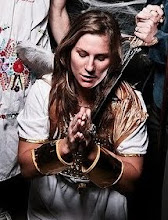
I, Candle, full of lum-escent flame, burn brightly.
There's not much that I can't handle, except maybe sharing the spotlight. Too many burning wicks produce too much heat and smoke and soon blend into every other.
And then my overshadowed flame, flickering slowly and seeking return to glory, finds an open space to once again burn brightly.
Thursday, August 6, 2009

Tuesday, May 12, 2009
Remain Mystified
You can fly away electric bird.
I wonder where angry protesters live these days. I wonder where the angry protester is in all of us. It seems to me that we've rolled over and sold out; that we have no fight in us because we're too busy marketing ourselves to the world. Maybe we should come with a price-tag.
We whore around, and there's no denying it. So, as much as you don't want to hear my complaining, you probably need to. I'm an optimist, and I'd like to think that I'm a pacifist, but I have too quick of a temper. I also have a sense of inner calm within me, in the midst of my most uneasy or violent emotions. I always know that "this too shall pass," and that there is always the state from which everything arises and to which everything returns. I trust in the cycles of life, despite my desire for pleasure like the next person.
Negative emotions, violent emotions, are pure life-force. I'd rather that than wake up one day and realize I've lived my whole life trying to please or pacify others, when what pleases them makes me miserable and inauthentic. Fire burns us, but it is essential to all of our inner processes, including digestion. It carries within it the power to transform. So, we can rest assured that it is a part of us.
Fire, or anger, can also be destructive. Anger scares people, yet is healthy. It can be a light for us; it can show us where we need to pay special attention.
These days, I am well, despite the vicissitudes of life and the fact that I have been burned. I feel like I am returning to life, maybe reawakening, as though I am moving out of a cycle of darkness, like a long waking up, stretching, and yawning. I don't think we have to be angry to wake up. I don't think we have to move into the extremes to be alive. Instead, I feel like there should be a certain kind of movement within; and if not anger, then sensitivity and acute awareness to reality, life, truth, and the conditions of others and in which we live.
What I am moving against is the deadening of our ability to feel slighted, to feel outraged, to feel affected by injustice. Healthy acceptance isn't indifference or powerlessness. Healthy acceptance is dealing with the emotions that accompany our impermanence and the experience of multifarious injustices. It's letting those powerful emotions move through us, unimpeded. We merely watch them.
But, that takes awareness and sensitivity and the intention to do so. Often, I have failed to address a slight. I have forgiven an unlimited amount of times, not knowing how to erect and guard my own boundaries. And though I know people sometimes commit slights unintentionally, I am trying to learn to react in a balanced manner. As of late, I am more intolerant of slights and people's mistakes, even if done so unintentionally. I forgive, yet I do not afford them the opportunity to do it again. I am full of knee-jerk reactions, yet also have the mind to follow up.
Once is enough; twice is too much. The thing is, I'm guilty of letting others commit the same offenses multiple times before my bill is due and I come to collect. I suppose I've reached my quotient of asshole offenses and thoughtlessness; I suppose this is the nature of the parabola. Now, I'm trying to regain my equilibrium. I know I cannot hold people to the standards I would hold a significant other; however, I don't think that's the issue. In fact, I think the problem is that I trust too easily and give away my affection at will. I haven't learned to discern between those who are deserving and those who are not. I haven't learned to trust when it is a natural consequence of time and experience.
It feels petty to me to have to look at people with a discriminating eye and with suspicion. Aren't all people good? At heart? Maybe Western and Eastern ideas are clashing within me. The idea of "evil" is not quite gelling well. Is there such thing in the modern and Western sense? Or is evil truly just ignorance? Or is it both?
Maybe it's both. Maybe there is such thing as evil, and it begins as the seed of ignorance and exists because of the cloak of ignorance veiling the truth. Maybe under this cloak, we are able to commit horrific, and lesser, crimes against humanity. I know that most times I commit a slight, it is because I am not aware of the affect it has on the other person. On the other hand, there are those who commit great evils, knowingly. I understand, from a Buddhist perspective, that good and bad really are just reflections of the One, of pure awareness, but one side is limited.
What I've established is that we are limited in our rational awareness. We fail to see all sides. This makes me feel like our little consciousness is operating through the sight of a pinhole. This is not so comforting. A Buddhist would say that no one can really hurt us; it is only what we perceive, and our mind is the creator. That our experience is truly subjective. I get that. But, discovering certain ideas, or even truths, pushes one to assimilate these ideas into one's worldview for some kind of continuity. In that respect, we then seek some kind of operation manual, as if operating a fighter jet. If "A" happens, then "B." As creatures of habit, we desire a manual. Is there such thing? (Perhaps, this is where the concept of a "paradigm" comes in.)
"Ahhh. OK. She did this. Now, how should I react?" Some of our reactions are habitual, knee-jerk reactions, and some of them come from our decision to act one way or another. Our power lies in our choice, and our habits rob us of our ability to choose. So, this all seems truly subjective, which lends itself to relativism, and which is hard for me to swallow. Something can be and not be. Absolutes or no absolutes. It IS wrong to murder, but we decide when it is "right" or "convenient" to uphold that absolute. In a time of war, it is merely "killing," and killing is not "wrong." Or is it?
A change of pace. What we seek, or what I am seeking, is peace in relation to life, but that is not always possible. Some people just don't get along, and some circumstances just aren't suitable. So that leads us to what is most natural to us.
We seem to be hardwired in some ways and not in others. If it were possible with current technology, could we upload, as in software, certain traits or habits or beliefs? Could we upload false memories which, in turn, would create specific conditions and reactions within a person? How in control are we? Are we held prisoner by our impulses, beliefs, and tendencies? Are we held prisoner by our memories and inheritances? Or is this a natural adaptation or defense mechanism, thanks to our lower animal selves?
Maybe the concepts in "The Matrix" aren't so far out? I'm saying that all this "reality" seems to be make-believe or a child's plaything. That reality isn't as objective as we'd like to believe. That there is apparent chaos in the infinite and finite order of things.
Our inner processes and the processes that underlie all of life are ordered and organized; yet, this seems to produce a chaos. Or the issue is that we aren't able to perceive orders of that level, a level that supersedes all current mental faculties.
Or it could be nothing, and all could be random, if you so choose to believe. However, just because you believe something doesn't make it true, in reality--such things like delusions exist. This means to me that there is evidence of something objective in the world, such as "laws of the universe." Maybe the thing that creates all this complexity really boils down to one simplicity: energy and the fact that energy has an infinite attribute: It cannot be created or destroyed. It is infinite in scope and eternal and operates according to certain fixed laws. (And do these laws operate by habit, as we often do, and as Rupert Sheldrake asserts in his theory on "morphic resonance.")
So like fireworks, we start out from one point and burst forth on to the screen. Now just magnify that fireworks show across the universe, and we can see how great the potential is for everything. One of the most curious and interesting things is how something could be so simple, yet so complex because that is its nature.
Talk about stretching the mind.
Maybe whatever choices I make really only reflect slivers of the whole, and I'm necessarily trying to get all I can out of what carries an infinite amount of potential. I have felt "this" and "that" and have been most uncomfortable and comfortable, and I want to understand what it is like exactly as this being, in this body, to add to the pages and pages of other lives and their experiences. (And for what? That question is an end in itself because life is happening not for a particular end, as a means to an end, but is an end in itself.)
I've already lived and died in this flash, in this moment of time. So, I'm not sure what's to fear, except that it's human nature to fear, and that I am not above being ordinarily human.
I am a stranger in a strange land, and all this around me, including you, is also me. I am living in multiple worlds at once. And maybe I'm discovering that equilibrium and am fostering relationships that don't reflect incompatibility and false intimacy.
Now what? I'll take this and live as genuinely as I can and experience as much humanity as possible. I will do the thing I do best: remain mystified but always forward-moving.
Sunday, April 12, 2009
Easter Egg Hunt
My thoughts turn to numinous images embedded in my psyche: different notions of salvation. One can walk on water and bring the dead back to life with the power of faith.
If hope is to a Buddhist the negative admission of lack, and if hope is to a Christian or Jew the positive admission of desire, then hope is neither indulgence nor necessity. I'm not so sure about hope, though. Maybe there is a hope found in the Middle Way.
The most difficult thing to do is to be yourself: to embrace freedom and your singularity. We spend an inordinate amount of time running away from, instead of toward, ourselves.
I'm on an Easter Egg Hunt. I'm seeking the indestructible within.
If hope is to a Buddhist the negative admission of lack, and if hope is to a Christian or Jew the positive admission of desire, then hope is neither indulgence nor necessity. I'm not so sure about hope, though. Maybe there is a hope found in the Middle Way.
The most difficult thing to do is to be yourself: to embrace freedom and your singularity. We spend an inordinate amount of time running away from, instead of toward, ourselves.
I'm on an Easter Egg Hunt. I'm seeking the indestructible within.
Tuesday, April 7, 2009
Yeah, We've Got It All Fucked Up
We've got it all fucked up when the TV's higher than the temple.
We've got it all fucked up when the money symbol $ is higher than the heavens.
We've got it all fucked up when we grind ourselves to the bone into the deep blue future.
We've got it all fucked up when we've lost face to accompany the pretense of our most banal and mundane dreams.
We've got it all fucked up when the money symbol $ is higher than the heavens.
We've got it all fucked up when we grind ourselves to the bone into the deep blue future.
We've got it all fucked up when we've lost face to accompany the pretense of our most banal and mundane dreams.
Thursday, March 19, 2009
Satiation
Mistaking attachment for love is an easy thing to do. Mistaking addiction for love is also an easy thing to do. The two, attachment and addiction, seem to be intertwined or fruits of the same seed.
We may hold on to a thing because of our attachment or addiction to it, but it doesn't mean that the thing is healthy or right for us.
A drug may feel good, but it has deleterious effects and the feelings are short-lived. The same goes for certain relationships, such as the ones fueled by co-dependency or dependency.
How much we cling to a thing may serve as a litmus test for whether or not it is attachment, addiction, or love.
I'd goes as far to say that the things, particularly relationships, that are healthiest for us are things that do not cause withdrawal or pain during separation. In the first stages of love, we experience the fits of first love: the wanting, needing, lusting, aching. We must be around the other.
Later, as a deeper love comes through, the fits or highs of love subside, as the love/lust is no longer a thirst to be quenched or a hunger to be sated. Like Donne writes in "A Valediction Forbidding Mourning":
...Dull sublunary lovers' love
—Whose soul is sense—cannot admit
Of absence, 'cause it doth remove
The thing which elemented it.
But we by a love so much refined,
That ourselves know not what it is,
Inter-assurèd of the mind,
Care less, eyes, lips and hands to miss.
Our two souls therefore, which are one,
Though I must go, endure not yet
A breach, but an expansion,
Like gold to aery thinness beat.
If they be two, they are two so
As stiff twin compasses are two ;
Thy soul, the fix'd foot, makes no show
To move, but doth, if th' other do.
And though it in the centre sit,
Yet, when the other far doth roam,
It leans, and hearkens after it,
And grows erect, as that comes home.
Love can stand the distance; yet, dull love--such as lust, addiction, or attachment--needs constant attention. The feelings involved in attachment and addiction are heightened, erotic, and impulsive. The feelings involved in love are like a pervasive, quiet hum--constant in its regularity and continuity.
Relationships characterized by attachment and addiction are crutches or substitutes for something going on beneath the surface, perhaps psychologically. Where there may be emptiness or loneliness, relationships characterized by attachment and addiction come in to make full. However, these do not last, as they climax and come to an end, a kind of "coming down" from a high. These "users" are addicted to love and to the drama, passion, and excitement involved.
I'd say that love is not like the satiation that comes from eating a hearty meal, only to be hungry hours later. I'd say that love is the satiation that comes not from needing, but from already being full and wanting to give. It is characterized by reciprocity.
Because of this reciprocal exchange, constancy, and satiation, relationships based on love can withstand the tests of time and distance, as Paolo Marinetti so poignantly framed:
"Watching the distant darkening hills, the trees bending with the black weight of your absence, I think of you...and you are always with me, watching the clouds hurry over the dangerous waking seas, the islands biding their time like whales. Let us smile together, safe in our love that conquers distance, contented even in the bleak landscapes of separation."
I'll take Marinetti's words as prophetic insight into my love life: Though we are separated and, perhaps, have never even met, we can smile together, safe in our love that conquers distance, for we will one day be able pay homage to a love that has existed across space and time. And though our two hearts may break (in between our reunion), the larger heart we form will never break. It cannot be broken.
We may hold on to a thing because of our attachment or addiction to it, but it doesn't mean that the thing is healthy or right for us.
A drug may feel good, but it has deleterious effects and the feelings are short-lived. The same goes for certain relationships, such as the ones fueled by co-dependency or dependency.
How much we cling to a thing may serve as a litmus test for whether or not it is attachment, addiction, or love.
I'd goes as far to say that the things, particularly relationships, that are healthiest for us are things that do not cause withdrawal or pain during separation. In the first stages of love, we experience the fits of first love: the wanting, needing, lusting, aching. We must be around the other.
Later, as a deeper love comes through, the fits or highs of love subside, as the love/lust is no longer a thirst to be quenched or a hunger to be sated. Like Donne writes in "A Valediction Forbidding Mourning":
...Dull sublunary lovers' love
—Whose soul is sense—cannot admit
Of absence, 'cause it doth remove
The thing which elemented it.
But we by a love so much refined,
That ourselves know not what it is,
Inter-assurèd of the mind,
Care less, eyes, lips and hands to miss.
Our two souls therefore, which are one,
Though I must go, endure not yet
A breach, but an expansion,
Like gold to aery thinness beat.
If they be two, they are two so
As stiff twin compasses are two ;
Thy soul, the fix'd foot, makes no show
To move, but doth, if th' other do.
And though it in the centre sit,
Yet, when the other far doth roam,
It leans, and hearkens after it,
And grows erect, as that comes home.
Love can stand the distance; yet, dull love--such as lust, addiction, or attachment--needs constant attention. The feelings involved in attachment and addiction are heightened, erotic, and impulsive. The feelings involved in love are like a pervasive, quiet hum--constant in its regularity and continuity.
Relationships characterized by attachment and addiction are crutches or substitutes for something going on beneath the surface, perhaps psychologically. Where there may be emptiness or loneliness, relationships characterized by attachment and addiction come in to make full. However, these do not last, as they climax and come to an end, a kind of "coming down" from a high. These "users" are addicted to love and to the drama, passion, and excitement involved.
I'd say that love is not like the satiation that comes from eating a hearty meal, only to be hungry hours later. I'd say that love is the satiation that comes not from needing, but from already being full and wanting to give. It is characterized by reciprocity.
Because of this reciprocal exchange, constancy, and satiation, relationships based on love can withstand the tests of time and distance, as Paolo Marinetti so poignantly framed:
"Watching the distant darkening hills, the trees bending with the black weight of your absence, I think of you...and you are always with me, watching the clouds hurry over the dangerous waking seas, the islands biding their time like whales. Let us smile together, safe in our love that conquers distance, contented even in the bleak landscapes of separation."
I'll take Marinetti's words as prophetic insight into my love life: Though we are separated and, perhaps, have never even met, we can smile together, safe in our love that conquers distance, for we will one day be able pay homage to a love that has existed across space and time. And though our two hearts may break (in between our reunion), the larger heart we form will never break. It cannot be broken.
Wednesday, March 11, 2009
Simple Animal
I'm like a little dog, tail wagging, only wanting to pee on and lick everything.
Don't blame me for my simple, animal nature.
When I'm hungry, feed me. When I'm thirsty, let me drink from your cup...
Don't blame me for my simple, animal nature.
When I'm hungry, feed me. When I'm thirsty, let me drink from your cup...
Saturday, March 7, 2009
Milk
It's the milkmaid:
There's milk in the fridge,
on the porch and the bedside table.
It's the milkman, Grandma.
How many daddies does it take to father nine kids?
"How many?"
You tell me.
There's milk in the fridge,
on the porch and the bedside table.
It's the milkman, Grandma.
How many daddies does it take to father nine kids?
"How many?"
You tell me.
Subscribe to:
Posts (Atom)